

Ready to Embark on an Exciting Journey with WIN?
Take the first step toward personal and financial freedom by filling out the interest form. One of our franchise advocates will be in touch with you soon!

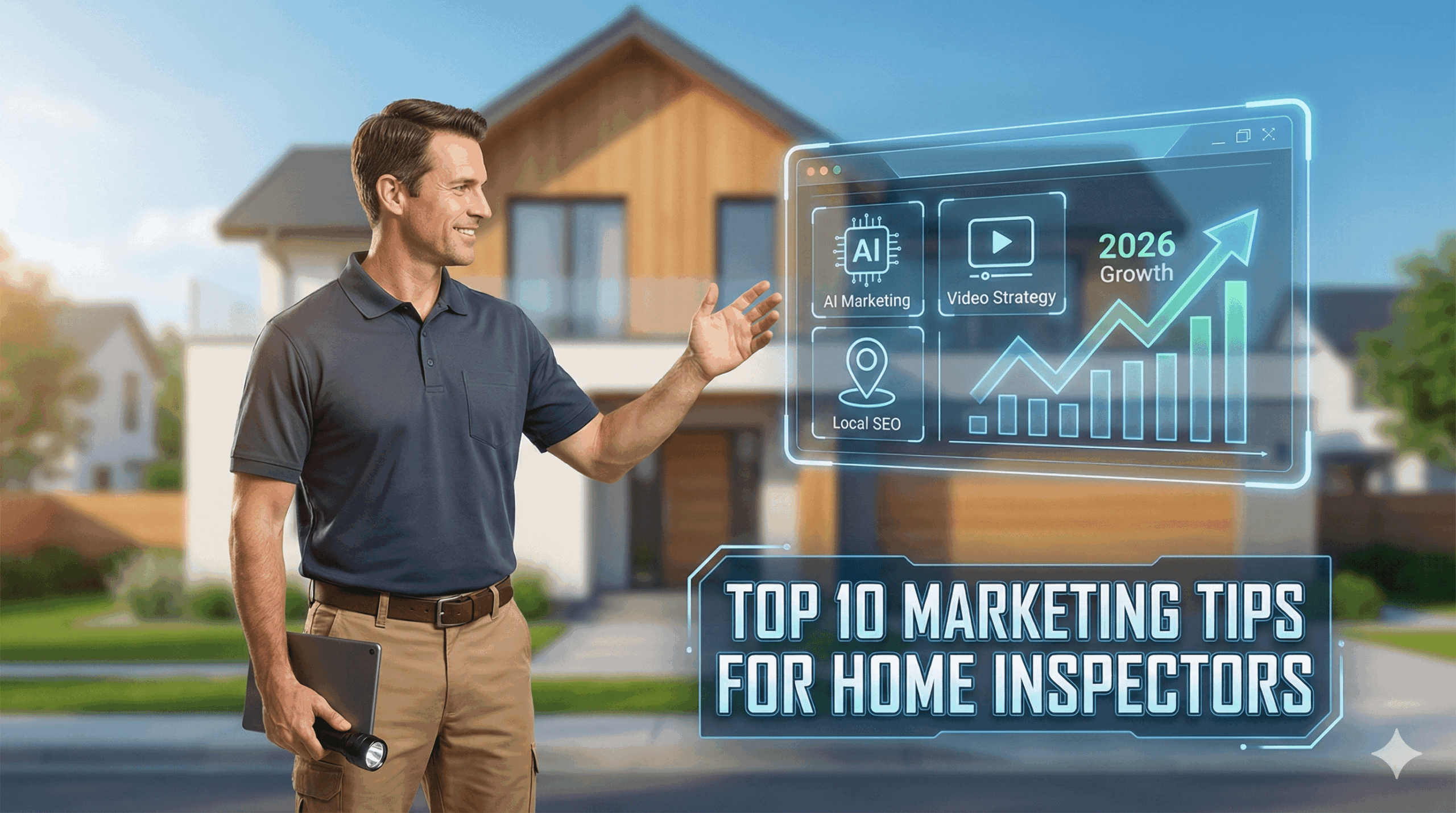
The real estate landscape is changing fast as we move into 2026. Home buyers are more tech-savvy and independent than ever before, using online tools to do their research. The National Association of REALTORS® predicts a housing market comeback with 14% more sales than in 2025. Redfin says 2026 will be a buyer’s market with plenty of options for sale.
Buyers aren’t waiting for their real estate agent to hand them a name. Instead, they are looking up reviews, checking websites, and comparing inspectors on their phones long before making a call.
What worked for agents and home inspectors five years ago may not be enough to compete today.
That’s why home inspectors, just like real estate agents, need marketing strategies that get results. Discover 10 practical ways to grow your inspection business this year.

Over the past two years, AI-based tools like ChatGPT, Gemini, and Perplexity have made headlines. These AI-based platforms have made marketing much easier for your business.
Rather than creating a 3,000-word complete guide on home inspections, you can prompt AI to create a marketing plan and deliverables that take care of 90% of the work for you without hiring a marketing expert.
AI-based software can deliver much more than a long blog. Treat these tools like an intern doing most of the marketing work for you.
Consider investing in programs that can repurpose one piece of content into everything you need for the week. The key is to ask the AI tool to create what you want. The more details it has, the better content it produces.
See these three methods to easily create content for the upcoming week.
a) The “Photo First” Method
Take a picture of a defect during an inspection, like a double-tapped breaker.
Upload it to an AI tool. You may have to create a free account to use your chosen AI platform.
Ask the AI to write three things. First, a short Instagram caption explaining the danger. Second, a slightly longer Facebook post for homeowners. Third, a quick email tip for realtors at less than 100 words.
b) Automate the Mundane, Boring Stuff
Set up an AI agent to automatically write and schedule generic maintenance reminders. Two great examples are to change your air filters or clean your gutters. Make the content relevant to your city’s weather. This keeps your feed active even when you are too busy to post. It also posts relevant content for your target audience. For social media, don’t forget to include hashtags.
c) The 11-Month Check-In
Use AI to scan your past reports. You can upload PDFs or Word documents into your chosen tool, and it can scan the documents to get the information it needs. Draft personalized 11-month warranty inspection email reminders for clients whose home warranties are about to expire. Your email tool should automatically incorporate the client’s name, address, and other relevant information regarding their home.
Our pro tip is to always review AI-written content for accuracy and to make it sound human. AI is great at volume and creating thousands of words of copy in mere minutes. The downside is that AI-based writing can sound robotic and monotonous. Always take a minute to read the output. Make edits, too, before you publish anything.
If the AI uses words you would never say in real life, like delve or tapestry, delete them. You can always prompt AI ahead of time and save the prompt to help it sound more like your branding and messaging.

More and more people turn to short-form videos, like on TikTok or Instagram Reels, to find information. Static photos of houses simply aren’t enough to stop the scroll anymore.
Algorithms on Instagram, Facebook, and TikTok aggressively favor short-form video. Don’t forget about YouTube Shorts. If you are not posting a short video or two every week, you are voluntarily cutting your reach in half.
A vast majority of adults in the United States (84%) use YouTube, while 71% use Facebook. Half of adults use Instagram, while 37% use TikTok, according to Pew Research. So, favoring these four platforms can lead to big results.
You do not need to be a professional influencer or do silly dances to get noticed on social media. Potential clients want to see your expertise rather than high-production value. They want to trust that you know what you are looking for. The goal here is to be authentic and educational. Many modern smartphones have video cameras with high enough resolution and editing tools to capture everything you need to make a great 30-second or one-minute video.
Start by looking at what other home inspectors already have on these four platforms. What are the most popular videos? How many times have the videos been watched, shared, or liked? What are the comments on the videos? Seeing what others have done before you can give you ideas of what your audience is looking for.
Consider these three types of videos to post on social media.
a) “What Is This?” Clips
Point your phone’s camera at a strange defect, like a roof leak, pest infestation, or frayed wire. Explain the defect in 15 seconds by saying what it is, why it matters, and how to solve it. These videos get high engagement because they are genuinely interesting and provide actionable items.
b) The “Walk-Through” Teaser
Speed up a video of you walking through a home to show how thorough your process is. It shows clients you look everywhere in a home.
c) Homeowner Q&A
Answer one common question a homeowner needs to know. Perhaps, “How do I turn off my main water valve?” This positions you as a helpful resource, not just a service provider. Do this once or twice a week. Remember, these videos don’t have to be long.
Our pro tip is to follow the one-take rule. Do not overthink the editing. The most viral videos often look like they were filmed in one take on a regular phone. Imperfection makes you look real and trustworthy. Just hit record, speak clearly, and post it.
Videos should be 30 seconds to one minute long. It’s as simple as that, as if you are speaking to a real customer.
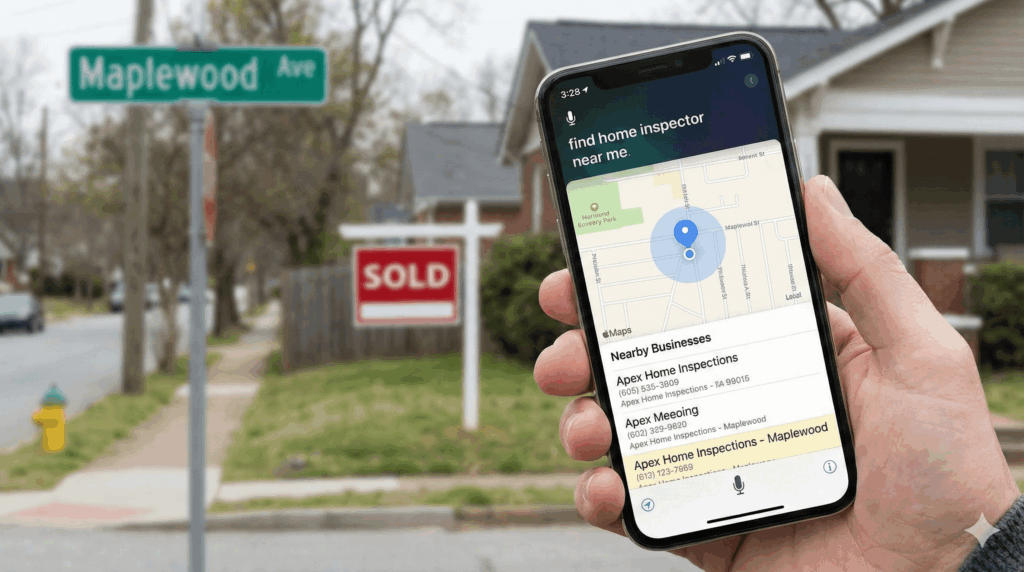
Voice searches using Siri, Alexa, or Google Assistant continue to increase. Rather than typing in keywords on a computer, people ask questions like, “Who is the best home inspector near me?” or “How can I find a great home inspector in this area?” If the person is in their vehicle, the phone will use its GPS to find a home inspector nearest to where they are driving.
If your website and social media aren’t set up to answer that question, your potential clients can’t find you. Remember, people may be out looking at a potential home to buy when they are searching for your home inspector business.
You must prove to search engines that you are the local authority. Google prioritizes businesses that show they are active and relevant in a specific neighborhood or town, not just a general region. It will compare your business name and address found on the website to other sources on the web to make sure they are the same.
a) Optimize Your Google Business Profile
This is your most important asset. Fill out every single field with as much relevant information as possible. Upload photos of local landmarks or identifiable neighborhoods you inspect. Post photos or videos of your inspection process without giving away personal information about your clients. The more active you look, the more Google trusts you are a real local business. A good cadence is to post at least five photos per month.
b) Write Like People Talk
Your website content should sound like a conversation rather than simply posting keywords for the sake of getting noticed. Instead of just listing “Home Inspection Services” as a page, include an FAQs section with questions written exactly how people ask them. Consider, “How much does a home inspection cost in [Your City]?” or “Do I need a radon test in [Your County]?” These local keywords identify where your company is located and where it operates, giving Google more reasons to rank your business in a local search.
c) Create Community Pages on Your Website
Do not just list the major city you serve. Create specific pages for the smaller suburbs and towns nearby. When someone in a specific suburb asks for an inspector, your page for that exact town is more likely to pop up than a generic city page. Make sure to take photos and videos of that neighborhood or suburb and post them on that page. Google favors pages with visual elements that aren’t stock photos.
Our pro tip for local SEO is that robots don’t buy houses. People do. When your online presence mirrors how real people speak and ask questions, you naturally rise to the top of the search results without needing to be an SEO wizard. Yes, you need to get the attention of the GoogleBot Overlords. But Google doesn’t buy houses.
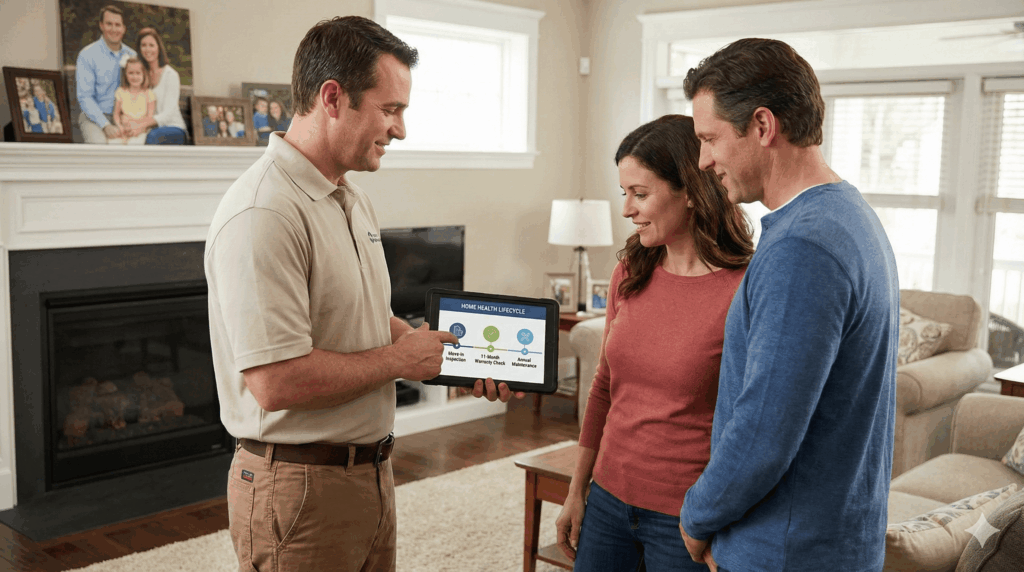
Most inspectors wait for a house to be sold to get work. But this strategy isn’t reliable if the housing market slows down. Adopt a growth mindset. Sell inspections directly to people who already own homes.
These are known as lifecycle inspections because they happen during the life of homeownership, not just at the start.
Stop treating your business as purely transactional. You don’t want to be the person who shows up once and disappears. You need to become the house doctor who provides regular check-ups to make sure the patient is in good working order.
The lifecycle inspection approach relies on building relationships with homeowners. You could create recurring revenue that does not depend on realtors. Think of this as hiring an accountant who does financial checkups on a business every quarter rather than just relying on doing income tax returns every spring.
Look at three things you can do to increase the number of inspections you perform.
a) 11-Month Warranty Inspections
Target new construction buyers one month before their builder warranty expires. This is the easiest sell in the industry because finding just one defect usually saves the homeowner more money than the cost of your fee. This gives the homeowner one month to leverage the builder’s warranty.
b) Annual Maintenance Check-Ups
Offer a lighter, faster inspection for homeowners who want to know what to fix before winter. It gives them peace of mind and keeps your schedule full during slower months. Think about inspections for the HVAC system, insulation, roof, doors, and windows that could let in cold air.
c) Pre-Listing Inspections
Market directly to sellers who want to fix issues before a buyer finds them. This puts the control back in the seller’s hands and speeds up their sale. As soon as a home hits the market, reach out to the homeowner or the real estate agent.
Our pro tip on how to sell lifecycle inspections starts with your client list. You do not need a realtor for this. Send a simple email to clients from 10 months ago or two years ago, reminding them of these services. The message is simple: “Protect your investment before it costs you more.” Keep the call-to-action straightforward and get to the why quickly.
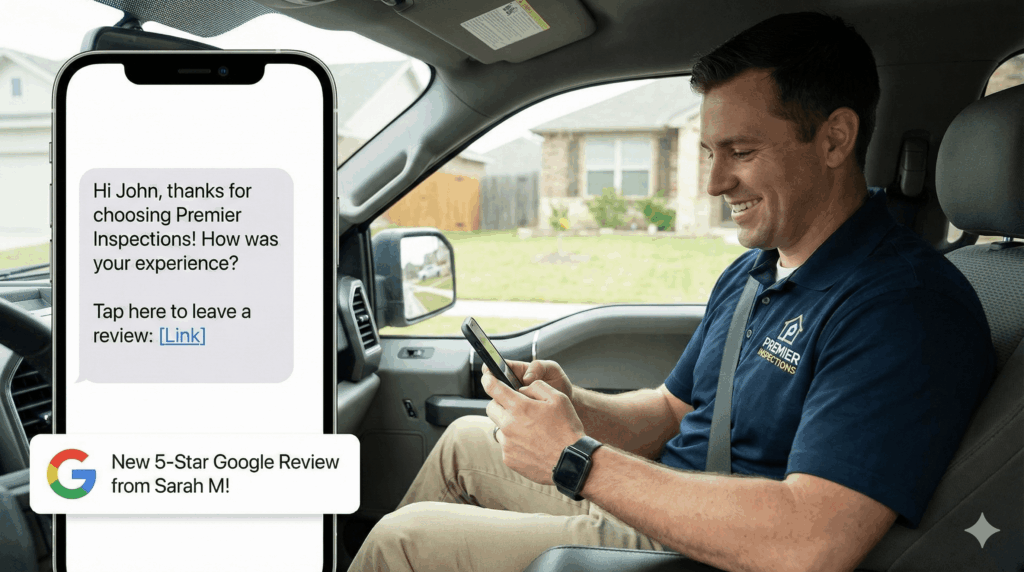
Your reputation is everything in the home inspection business. Today, a referral from a friend is good. But what about people who read reviews? A bevy of recent 5-star ratings on Google is what seals the deal.
The difficulty is that satisfied clients often forget to leave a review. Unhappy clients, if there are any, never leave a review. You cannot leave reviews to chance or someone’s memory after the transaction is complete.
Just like you need to remove sales friction, you need to remove the friction from the review process. If a client has to search for your business name to leave a review, they won’t do it. That’s already too hard.
If you have to remember to ask them manually, you will forget. The goal is to make leaving a glowing review the easiest part of their day. And there are some great tools to help you do this.
Just like you can automate marketing, you can tap into technology that gets more reviews.
a) Request a Review at the Right Moment
Set your report software to send a review request to a customer automatically. The best time is usually the morning after they receive the report. They are relieved to have the information and trust you the most at that specific moment. Keep the verbiage light and simple, like “If you felt my services delivered as expected, please leave a review.”
b) Text Over Email
People ignore emails, but they almost always read text messages. Forbes reports that text messages have a 98% open rate versus just 27% for emails. Send a polite, automated text with a direct link that opens the “Write a Review” box immediately. Do not make them click twice. It should open directly into a review window. Remember, to leave a Google Review, the customer needs to have a Google Account. They might already have a Google account if they own an Android phone.
c) Respond to Everything
Automate a “thank you” notification so you can reply personally after someone leaves a review. Responding shows future clients that you are grateful and active. If they leave a Google Review, log into your Google Business Profile and respond publicly. Do this even for a negative review because it shows you care about the customer’s opinion, good or bad.
Our pro tip is that volume matters. A profile with 200 reviews looks significantly safer to a nervous homebuyer than a profile with 15 reviews, even if both have a 5.0 rating. Automating the process is the only way to get that volume consistently. Aim to get at least 10 to 15 new reviews per month to help your profile rank in a local search on Google.

Gone are the days when dropping off a box of doughnuts at a real estate office guaranteed you a referral. Real estate agents are mobile, stressed, and focused on efficiency when trying to keep their business moving forward.
These professionals do not care about free snacks. They care about who makes their job easier and who helps them close deals without headaches. Your home inspection business needs to meet real estate agents where they’re at.
The best way to win an agent’s loyalty today is to save them time. If you are hard to book or your reports are difficult to read, they will find someone else. You need to position yourself as a seamless partner and not just a vendor.
Think about these three things to enhance your relationships with real estate agents.
a) One-Click Scheduling
If an agent has to call you to check availability, you have already lost. Give them a link where they can book a slot instantly from their phone while standing in the kitchen with their client. It’s simple and takes less than a minute versus calling you, leaving a message, and waiting to hear back from you.
b) Repair Request Tools
Use modern reporting software that automatically creates a repair request list. Think of this as the executive summary of your report. This allows agents to build their repair addendum in seconds rather than spending hours copy-pasting from a lengthy PDF. They will love you for this feature alone because they don’t have to hunt down repairs in your report.
c) Instant Communication
Send automated text updates when the inspection starts and finishes. It keeps them in the loop without them having to chase you for updates. Also, give them a timeline when they should receive the full report if they don’t have one already.
Our pro tip is to make a real estate agent’s job easier. Doughnuts get eaten and forgotten. A tool that saves an agent two hours of paperwork creates a loyal partner for life. If they can rely on you, you can rely on them.
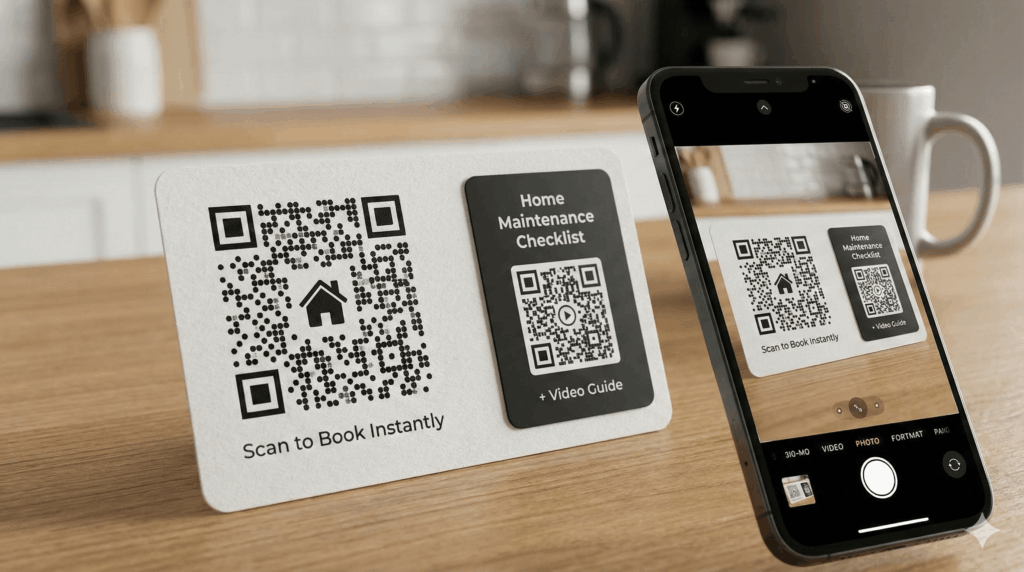
Online marketing is everywhere, but physical and tangible marketing materials are still relevant in today’s digital world. Generic brochures are fading fast because they already contain too much information. Handing someone a piece of paper that does nothing is a wasted opportunity.
Instead, your physical materials need to work smarter and harder by connecting the real world to your digital one.
Think of every business card, flyer, mailer, billboard, or vehicle wrap as a bridge. The goal is to move people from seeing your logo offline to taking an action online instantly. If they have to type in a URL manually, you will lose them.
Why is this important? Because you can track how they maneuver through your online marketing to develop personalized messaging for these types of clients.
Use these three methods to get people to interact with your online resources after using a physical marketing material.
a) QR Codes That Actually Work
Do not just link to your homepage. Put a large, clear QR code on your truck or brochure that links directly to your “Schedule Now” page or your Google Reviews. Make the destination specific and useful.
You can take this to the next level by having a QR code for a targeted marketing campaign by creating a landing page for this exact purpose. Have a winter special? Create a Winter Special page for an advertisement that a QR code links to.
b) NFC Business Cards
Swap your paper stack for a single digital card. You just tap it against an agent’s phone, and your contact info saves directly to their contacts. It looks impressive and ensures they never lose your number. Next time you call or text them, they’ll know exactly who is contacting them because your contact info is already there.
c) Value-Added Leave-Behinds
Instead of a generic flyer, leave a “Home Maintenance Checklist” magnet on the fridge or furnace. Include a QR code they can scan to see a video on how to change their air filter. It keeps your brand helpful and visible in the house for years.
Our pro tip is that you shouldn’t hand out paper materials that don’t lead to a conversion. Give someone a digital shortcut. Make it impossible for them to lose your information. You can track how many people land on your pages through these resources, thanks to Google Analytics.
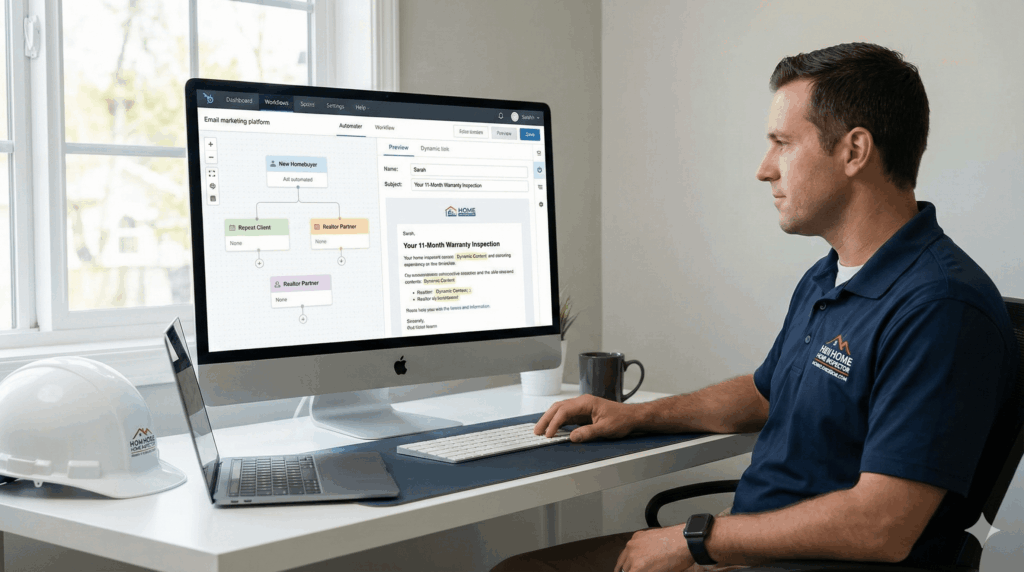
The “spray and pray” method of email marketing is over. It rarely works anyway. You could actually damage your email-sending capabilities if enough people label your messages as spam or unwanted.
If you send the exact same newsletter to a first-time homebuyer and a veteran real estate agent, you are wasting your time. People simply ignore generic emails.
They only open messages that feel like they were written specifically for them at that exact moment. Luckily, there are automated tools that can help you customize messaging to various segments, or buyer personas, of your target audience.
Organize your contacts into different buckets so they get the right message. You want to set up automated sequences, known as drip campaigns, that run in the background while you are out on inspecting jobs. Once you set these up, they run automatically. When contacts reach out to you along any steps of these drip campaigns, the automated email platform puts them in a different bucket.
Here are three examples of customer segments and how they work for your home inspection business.
a) The “Nervous Buyer” Email Sequence
For a scheduled client, send an email 24 hours before the inspection titled “What to Expect Tomorrow.” Include a photo of your truck, your photo in case they haven’t seen you yet, and a promise that you will explain everything about the inspection clearly. It builds trust before you even meet your new client.
b) The “New Agent” Onboarding
When you work with a new real estate agent, put them in a special email sequence. A real estate agent is a different buyer persona from a homeowner. Hence, you would have to create a different type of message. Send them a welcome email explaining your booking process, followed by a text a week later simply asking if they need anything.
c) The Seasonal Value Add
Do not spam past clients with company news. Past clients want to know how you can help solve their problems. Some of them may not even know they have problems to solve yet. Send them short, helpful tips based on the season. A simple email in November titled “3 Steps to Prevent Frozen Pipes” is valuable. A generic “Happy Holidays” email is just noise.
Our pro tip is to make email marketing not feel like marketing. Emails should feel like helpful communication from a professional who is looking out for you. There are many platforms out there that can help automate most of this process. You can segment your customers in any way you like until you land the sale.
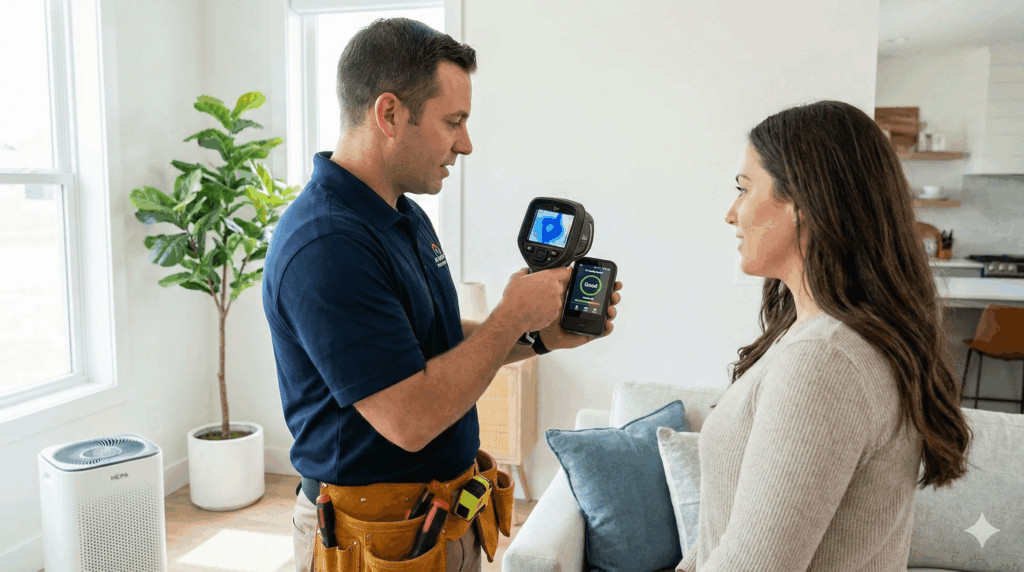
Today’s homebuyers are asking different questions than they did a decade ago. They are not just worried about the roof leaking or the foundation cracking. They are deeply concerned about invisible threats like mold, radon, and poor indoor air quality. Homeowners want to know if their home is something in which they can raise a family and later retire.
Homeowners also worry about rising energy costs. Do they know what kind of insulation is best for their home? Do they need to insulate their pipes?
If you only market standard structural inspections, you are missing a massive chunk of what clients actually care about.
You need to position yourself as a Healthy Home Expert rather than just a code inspector to land more business throughout the year. For instance, shift the conversation from “Does this house meet standards?” to “Is this house safe for my family to breathe in?”
Just like auto dealerships service vehicles after selling them, home inspectors can do so much more than just certify if a house meets a lender’s standards ahead of a sale.
a) Bundle Ancillary Services
Stop treating things like mold testing, radon testing, and water quality as optional add-ons hidden at the bottom of your price sheet. Create “Healthy Home Packages” that bundle these together for a flat rate. It makes the decision easy for the client and increases your revenue per inspection.
b) Show Off the Tech
If you use thermal imaging cameras, market them heavily. Do not just say you have one. Explain that it helps find missing insulation and drafty windows that will cost them money on heating bills. The same is true for drones. Drones make roof inspections easier without having to climb a ladder. Showcase your drone usage, too, mentioning you have a license to fly a drone in the course of doing business.
c) Talk About Safety and Health
In your marketing copy, focus on the benefits of energy efficiency and clean air. Use phrases like “Protect your family’s health” or “Lower your future utility bills.” This emotional connection is often more powerful than technical details about electrical panels. Seasonal allergies can be a big deal. Say how better indoor air quality can improve someone’s allergies.
Our next pro tip is that modern buyers want a safe and efficient home. When you show them you can verify both and demonstrate how they can make their home even better, you become the obvious choice as an expert.

We know. This is a big list. Implementing these marketing strategies can be a full-time job. You likely started this career to inspect homes, not to become a marketing agency. This is exactly why going independent is the hard path.
Fortunately, you have a partner here to help with your marketing. At WIN Home Inspection, we flip the script. Our franchise owners, whom we call Strategic Partners (SPs), don’t have to juggle marketing, licensing, and training on their own. We have the largest support and marketing team in the industry to handle the heavy lifting for you.
We provide brand value, business coaching, and technology at a price point no other franchise can touch. You could try to build all of this from scratch. Or you could partner with a team that already has the blueprint for success. Book a free consultation today. We’re happy to help build your home inspection business in any way we can!